


By John Huber, MarylandK12.com
January 12,2026
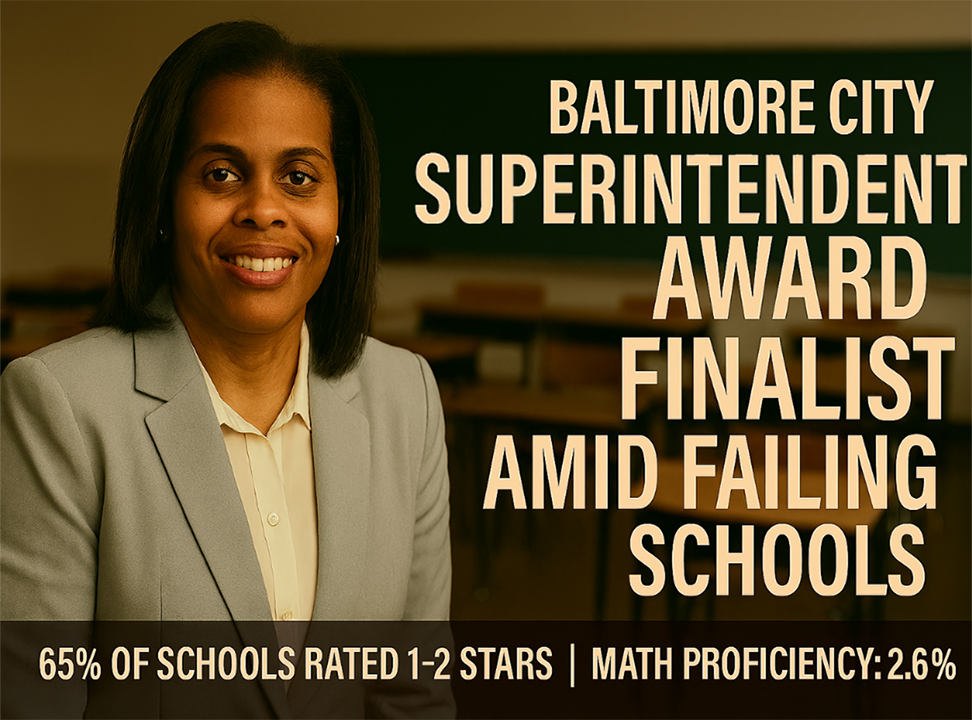
When the School Superintendents Association (AASA) named Dr. Sonja Brookins Santelises, CEO of Baltimore City Public Schools (BCPS), a finalist for 2026 National Superintendent of the Year, the celebratory press cycle kicked in—as expected. City Schools and local media highlighted ‘steady, sustainable progress’ across academics, community engagement, and leadership development, and they amplified endorsements from Governor Wes Moore and Mayor Brandon Scott. The narrative is polished. The data are not. In a district that remains Maryland’s lowest performing, with chronic gaps on both NAEP and MCAP, plus years of documented controversies, this nomination reads less like an honor and more like a disconnect from reality.
Performance Claims vs. NAEP Evidence
On the Nation’s Report Card (NAEP), Baltimore City’s student performance is nowhere near ‘steady, sustainable progress’ when set beside Maryland’s state averages or the large‑city cohort. In Grade 4 Mathematics, the district fell from 216 (2019) to 201 (2022), clawing back to 209 (2024); Maryland went 239 → 229 → 234 over the same period. In Grade 4 Reading, Baltimore City slid 193 → 185 → 186 while Maryland moved 220 → 212 → 216. Baltimore’s Grade 8 picture is worse: Math is flat at 245 (2022→2024), with Maryland at 269 → 268; Reading dipped 241 → 240 in Baltimore, while Maryland edged 259 → 258. These are not the hallmarks of districtwide ‘achievement gains’.
Figure 1 — NAEP Average Scores (Baltimore vs. Maryland)
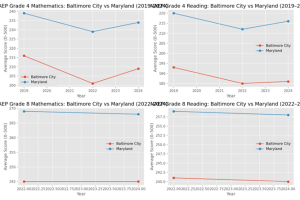
Source: NAEP Maryland State Profile & Baltimore City TUDA District Profile (2019–2024).
Figure 2 — NAEP % Proficient or Above (2024)
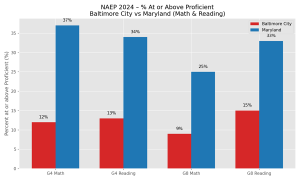
Source: NAEP 2024 State Snapshots (MD) & TUDA 2024 District Snapshot (Baltimore City).
MCAP: Maryland’s Own Tests Tell the Same Story
On MCAP, the statewide ELA proficiency for 2023–24 was 48.4%, and 2024–25 rose to 50.8%; statewide math increased from 24.1% to 26.5%. In Baltimore City, by contrast, ELA across grades in 2023–24 averaged ~27.7% (weighted by tested counts)—and math proficiency in 2024–25 sat at 12.6%, the lowest in Maryland.
Figure 3 — MCAP ELA (Baltimore City by Grade, 2023–24)
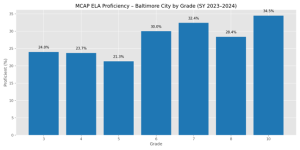
Source: Maryland READS Baltimore City profile (compiled from MCAP administrative data); MSDE ELA statewide benchmark.
Figure 4 — MCAP Math (2024–25): Baltimore City vs Maryland
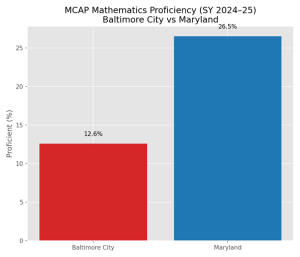
Source: MSDE (statewide) and WMAR summary of MSDE results (Baltimore City).
Accountability: Star Ratings Confirm Persistent Low Performance
On the 2023 Maryland School Report Card, 65% of Baltimore City’s rated schools were 1–2 stars—more than double Baltimore County (27.6%) and multiples of nearby districts (Anne Arundel 11.2%, Howard 4%, Carroll 2.7%). This is the state’s own rating system saying the city has the highest concentration of low-performing schools.
Figure 5 — MSDE Report Card (2023): % of Schools Rated 1–2 Stars
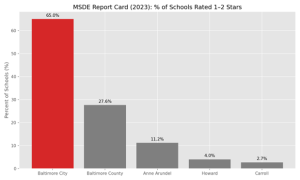
Source: WBFF analysis of MSDE Report Card release (Dec. 18, 2023).
Controversies Under Current Leadership
Public Records & Grade‑Changing (2017–2019): When journalists sought documents related to alleged grade‑changing, BCPS refused. In 2019, a judge ruled City Schools ‘willfully and knowingly’ violated the law, forcing disclosure. Title VI Investigation (2025): The U.S. Department of Education’s Office for Civil Rights opened a formal investigation into anti‑Semitic harassment allegations in BCPS, including claims of Nazi salutes. Procurement & Hiring Audit (2021–2023): A state audit found improperly awarded contracts (> $5M), > $142M in vendor invoices paid >90 days late, plus gaps in required screenings for personnel with access to children. Cybersecurity Breach & Operational Stress (2025): As the district faced budget strains and tutoring cuts, a cyber attack compounded operational challenges.
The Award Criteria vs. Local Reality
AASA’s press materials laud finalists for ‘steady, sustainable progress.’ Baltimore City’s data paint something closer to partial recovery in Grade 4 math, stagnation in Grade 8, depressed reading, and state‑leading low performance on Maryland’s accountability system. When a district’s NAEP proficiency rates are in the single digits and teens, and two‑thirds of schools sit in 1–2 star tiers, professional accolades should raise eyebrows—not banners.
A Call to AASA—and to Maryland’s Policymakers
The AASA selection committee should explain its criteria, weighting, and evidence base—publicly. What indicators of ‘steady progress’ were compelling enough to overshadow low achievement, audit findings, and an ongoing civil rights investigation? And if facilities and program expansions counted heavily, why weren’t student outcomes the decisive factors? Awards that downplay core academics and accountability risk becoming PR exercises, not professional recognitions. Maryland leaders should insist on transparent remediation plans, independent monitoring, and consequences when chronically low-performing systems fail to improve.
Dr. Sonja Brookins Santelises is certainly a dedicated, hardworking and caring educator working in a very difficult situation. Perhaps the above noted failures and disappointments are not all necessarily her doing and she is not solely to blame. But is the the record of a superintendent who is worthy of Superintendent of the Year?
Sources
- Baltimore City Schools announcement of finalist status (Dec. 16, 2025).
- Local media coverage of the nomination and rationale (WBFF/Fox45).
- MSDE press releases on MCAP results (Aug. 27, 2024; Aug. 26, 2025).
- Maryland READS — Baltimore City Profile (MCAP ELA by grade, 2023–24).
- WBFF analysis of MSDE School Report Card (Dec. 18, 2023).
- U.S. Department of Education OCR press release (Title VI investigation, Aug. 7, 2025).
- WBAL report on audit findings and CEO response (2024).
- WYPR Midday segment with CEO Santelises on budget/cyber breach (Apr. 29, 2025).
📄 NAEP Data (State & District)
- NAEP 2024 TUDA profile – Baltimore City (Proficiency & Scale Scores): NAEP 2024 Baltimore City TUDA Math/Reading Proficient Rates (Navigate to NAEP state/district snapshots for detailed district data) [reportcard…ryland.gov], [reportcard…ryland.gov]
- NAEP Maryland State Profiles 2024: NAEP State Profile – Maryland (Includes Grade 4 & 8 Math/Reading proficiency and scale scores) [reportcard…ryland.gov]
✏ MCAP Data (Maryland Assessment)
- MCAP 2024–2025 State Results (PDF): Maryland MCAP 2024–25 Results [marylandpu…chools.org]
- WMAR coverage — Baltimore City Math Proficiency 12.6%: Maryland English & Math Scores Increased; BCPS Math 12.6% [wmar2news.com]
📊 MSDE School Report Card
- WBFF report — 65% of BCPS schools rated 1–2 stars: In Baltimore City, 65% of public schools earn lowest possible scores [foxbaltimore.com]
🏆 AASA Finalist Announcement
- AASA press release — National Superintendent of the Year finalists: Finalists Named for AASA’s 2026 National Superintendent of the Year® Award [aasa.org]
⚖ Controversies & Investigations
- OCR (U.S. Dept. of Education) Title VI Investigation Announcement (Anti‑Semitic Harassment): DOE Opens Title VI Investigation Into BCPS [ed.gov]
- WBFF coverage — Despite Controversies, Santelises Named Finalist: Despite major scandals, Baltimore City Schools CEO named national award finalist [foxbaltimore.com]
- Maryland Dept. Legislative Services Audit (Feb 2025): Financial Management Practices Audit – BCPS [dls.maryland.gov]
- WBAL & Fox coverage — Audit findings (late payments, vendor issues):
- Cybersecurity Breach (Feb 2025):