Failure Factory and the Architecture of a Broken System in Baltimore City Public Schools
By John Huber MarylandK12.com
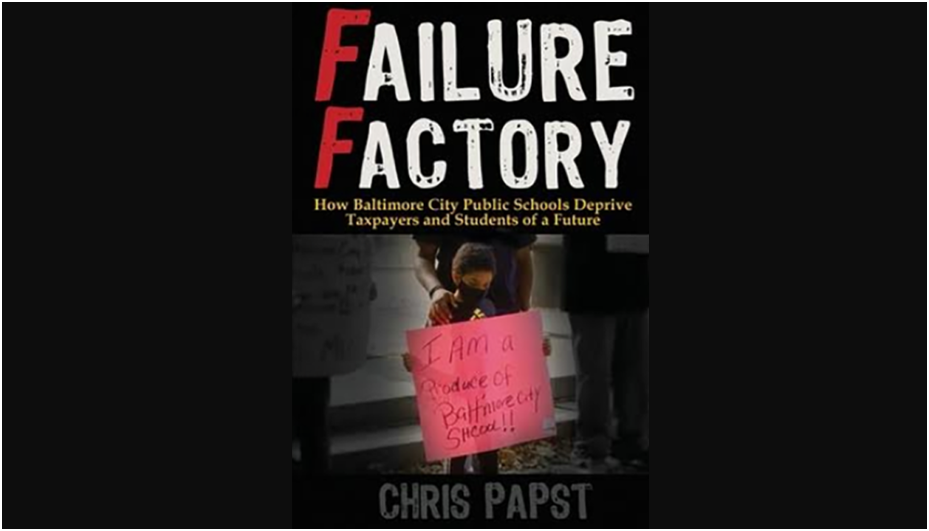
Chris Papst’s Failure Factory: How Baltimore City Public Schools Deprived Taxpayers and Students of a Future is not a polemic, nor is it a broad ideological critique of public education. It is something that is more difficult to ignore: it is a well- documented account of how a major urban school system systematically lowered standards, manipulated outcomes, and misled the public. And it did so while invoking the language of success and progress.
The phrase “systemic failure” has become so overused in education discourse that it sometimes means nothing at all. In Failure Factory, Papst show us what it really means in the day-to-day operations of our school system. The failures he documents are not abstract or theoretical. They are specific, traceable, and supported by records, interviews, internal communications, and court filings.
Papst brought the receipts.
A Reporting Project Years in the Making
Papst, an investigative reporter at Fox45 Baltimore and the founder of Project Baltimore, uses his years of reporting inside Baltimore City Public Schools (BCPS). His work chronicles how teachers and administrators were pressured, or outright directed, to change student grades to ensure passing rates and graduation numbers remained high.
The incentives driving this behavior are laid out plainly. Graduation rates are politically marketable. They protect leadership individuals and their reputations, preserve state and federal funding, and create the appearance of system improvement. Conversely, acknowledging academic failure is costly and difficult to manage.
Failure Factory shows how those incentives filtered downward and shaped day-to-day decisions inside classrooms and administrative offices. Teachers who resisted grade changes faced retaliation. Administrators learned quickly what outcomes were expected. Students were promoted and graduated despite lacking basic competencies.
What Papst uncovers is not a conspiracy in the cinematic sense, but a culture in which honesty became optional, and compliance was needed for professional survival.
Metrics, Optics, and the Drift Away from Learning
One of the book’s greatest strengths is how clearly it connects policy choices to real-world consequences. Papst demonstrates how accountability based on data such as graduation rates and promotion impedes the main purpose of schooling.
When systems reward appearance over substance, learning becomes negotiable.
The book illustrates how this drift happens incrementally. No single decision seems outlandish on its own. But over time, standards erode, expectations decline, and the meaning of a diploma changes. Students may leave school with credentials, but not with preparation.
Papst does not argue that educators set out to harm students. In many cases, he documents the opposite: teachers and staff attempting to do the right thing in an environment that punished dissent and rewarded silence.
Familiar Patterns for Education Insiders
Although Failure Factory is written for a general audience of those with no direct knowledge of the inside of K-12 public education in Maryland, it will also resonate strongly with those who have worked inside school systems; particularly large, centralized districts.
For parents and taxpayers, many of the details will be shocking. For current and former educators, much of it will, unfortunately, not be such a surprise. Grade inflation, pressure to pass students, and administrative avoidance of bad news are not unique to Baltimore. Papst’s reporting gives specificity to patterns that are often discussed only in the abstract.
That specificity matters. It prevents easy dismissal. This is not a case study built on anecdotes or ideology; it is a record of what happened, when it happened, and who said what.
The Transparency Mirage
One of Failure Factory’s most consequential contributions is its examination of how school systems avoid scrutiny. Papst details how districts deploy privacy laws, personnel protections, and legal language to obstruct public understanding, even when serious allegations are raised.
Parents seeking answers encounter bureaucracy at its best. Journalists face delayed or incomplete records. Even court actions do not always provide clarity. Throughout the book, Papst shows how “transparency” often exists more as a slogan than a practice.
The result is a public that is persistently informed too late, with too little detail, and with narratives carefully shaped by the institution under review. In this case, the reviewer was none other than the accused
In this sense, Failure Factory is as much about governance as it is about education. It raises uncomfortable questions about how public systems operate when oversight mechanisms are weak and reputational risk is high.
Accountability Without Villains
Notably, Papst resists the temptation to personalize the failure. While individuals are named where documentation requires it, the book’s focus remains on structures, incentives, and institutional behavior.
This choice strengthens the work. Readers are encouraged to ask harder questions than “Who is to blame?” Questions such as:
What behaviors are rewarded?
What truths are discouraged?
What outcomes are quietly acceptable?
These are the questions that determine whether reform is meaningful or performative.
Why This Book Matters Beyond Baltimore
Although rooted in Baltimore City Public Schools, Failure Factory has implications far beyond Maryland. The issues Papst documents, such as data driven accountability, reputational management, and the suppression of inconvenient data, exist across many large districts.
At a time when public confidence in institutions is fragile, the book challenges readers to consider whether official success stories deserve more scrutiny than celebration.
It also challenges policymakers and education leaders to confront a difficult reality: systems designed to protect themselves will eventually fail the people they are meant to serve.
A Necessary and Uncomfortable Read
Failure Factory is a first-hand account that succeeds because it allows documented facts to speak louder than generalizations or theory.
For anyone who cares about public education, government accountability, or the use of public funds, this book is required reading. It does not offer easy solutions, but it insists, convincingly, that pretending success is not one of them.
Dig Deeper With Our Longreads
Newsletter Sign up to get our best longform features, investigations, and thought-provoking essays, in your inbox every Sunday.
The MEN was founded by John Huber in the fall of 2020. It was founded to provide a platform for expert opinion and commentary on current issues that directly or indirectly affect education. All opinions are valued and accepted providing they are expressed in a professional manner. The Maryland Education Network consists of Blogs, Videos, and other interaction among the K-12 community.