Maryland Is Changing How School Performance Is Measured—Here’s What That Means
By John Huber · MarylandK12.com
For years, Maryland leaders have promised that more time, more reforms, and a lot more money would deliver better results. Yet as families watch reading and math outcomes stall, the state is moving to change how school performance is measured and shown to the public through House Bill 1582, the COMPASS Act. The bill doesn’t build a new system; it hands broad authority to the State Board of Education to redesign what counts, how much it counts, and how results are displayed, right as academic results remain stubborn.
(Sources: HB 1582 bill text; Fiscal & Policy Note; MSDE legislative update.)
What HB 1582 Does
House Bill 1582 (the “COMPASS Act”) changes the rules, not the final formula. In plain English:
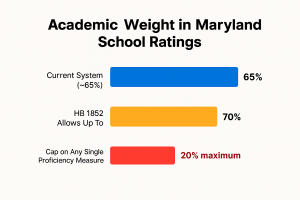
Academics may count up to 70% (today it’s about 65%), but any single proficiency measure is capped at 20%, and each academic indicator must count at least 10%. This spreads “academics” across multiple slices rather than letting one test dominate
School climate surveys become mandatory and the state may add more non‑academic indicators (staffing, class size, discipline/restorative practices, chronic absenteeism, access to certified/National Board teachers, and certain “completion” milestones). Most of these cannot be test‑based.
Teacher evaluations are barred from accountability calculations.
Composite score remains, but the 1–5 star system is no longer protected in law, allowing the State Board to replace it with dashboards or descriptive reporting without another vote.
Plain talk: The legislature loosens the guardrails and the State Board decides the details later.
HB 1582 raises the maximum “academic” share to 70%, but caps any single proficiency measure at 20%, spreading credit across multiple parts instead of anchoring it in mastery.
What to Watch if HB 1582 Passes
If the COMPASS Act becomes law, the most important changes will not happen immediately. They will occur later, inside State Board decisions that rarely draw public attention.
Does the star system survive?
The bill doesn’t ban stars, but it no longer requires them. Watch whether simple 1–5 ratings get replaced with dashboards or narratives that are harder to compare across schools.
How much do test results actually matter?
The total “academic” share might increase, but no single proficiency indicator can count more than 20%. Keep an eye on whether reading and math proficiency remain the clearest signals.
Which schools fall into the bottom 5% (CSI)?
Federal law still requires identifying the lowest‑performing schools, but redesigning the formula can change who gets identified even without academic improvement
Does transparency get clearer—or just more complicated?
If parents need multiple clicks, dashboards, and explanations to grasp performance, transparency hasn’t improved.
Blueprint funding vs. accountability clarity
As state spending rises, expect families to ask if Maryland is making accountability stronger, or just more flexible.
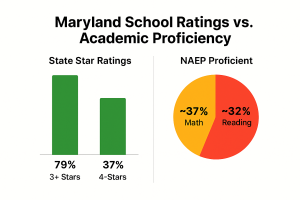
Maryland reported most schools as “average or better” (3+ stars) in 2023. On NAEP—the national benchmark—about one‑third of students meet “Proficient” in core subjects. (MSDE press release; NAEP state profiles)
The Narrative: Why This Moment Matters
Maryland’s public‑facing ratings already blend academics with a wide set of non‑academic indicators, which helps explain why a school can land in the “average” range even when reading or math proficiency is low. The state’s own release highlighted that the majority of schools earned 3–5 stars—a message that feels reassuring. Families, however, see national results showing only about one‑third of students meeting proficiency. The gap between what parents see (stars) and what students know (proficiency) is the accountability story of the past few years.
HB 1582 arrives precisely at that tension point. It raises the theoretical share for “academics” but simultaneously limits the effect of any single proficiency measure and expands the room for non‑academic indicators. It also hands the steering wheel to the State Board to decide whether parents will still get a blunt, comparable signal (stars) or a more descriptive, but less legible, dashboard.
Supporters’ best argument is equity: if ratings track demographics more than effort, a broader lens is fairer and more constructive. Critics’ response is accountability: if ratings don’t clearly reflect whether students can read and do math on grade level, then the system isn’t telling families what they need to know.
The CSI Question (Why Rankings Still Matter)
Federal law still requires Maryland to identify the bottom 5% of schools statewide and any high school with a <67% graduation rate for Comprehensive Support and Improvement (CSI). HB 1582 doesn’t change that. What can change is which schools fall into the bottom 5% after the formula is redesigned. If more points come from non‑academic factors, some schools could avoid CSI status without major gains in reading or math.
The Bottom Line
HB 1582 doesn’t erase accountability on paper, it redistributes it and shifts control from statute to the State Board, precisely when Maryland’s academic results remain underwhelming by national benchmarks. It raises the ceiling on “academics” while diluting the impact of any one proficiency measure, expands non‑academic credit, and uncouples the law from the 1–5 star signal parents actually understand.
If you believe the scoreboard should get clearer as the state spends more, this is the opposite move. It gives officials a wider lane to spread points across more indicators and repackage results in a dashboard that’s tough to determine at a glance. In plain English: the standards are changing at the exact moment the results are disappointing, and the people changing them will decide how the new picture is presented.
Will this lead to greater honesty in how Maryland reports student learning? Do Marylanders really believe that?
Newsletter Sign up to get our best longform features, investigations, and thought-provoking essays, in your inbox every Sunday.
The MEN was founded by John Huber in the fall of 2020. It was founded to provide a platform for expert opinion and commentary on current issues that directly or indirectly affect education. All opinions are valued and accepted providing they are expressed in a professional manner. The Maryland Education Network consists of Blogs, Videos, and other interaction among the K-12 community.