
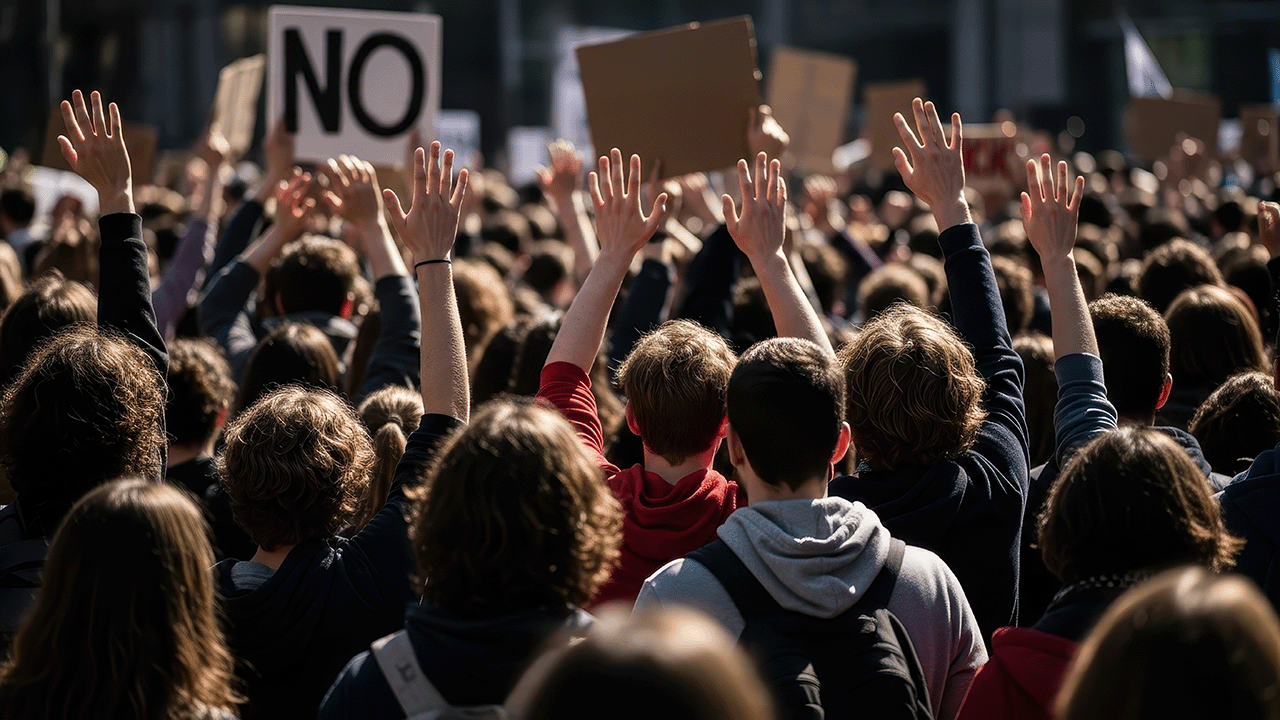
BCPS Has Opened the Doors: Student Protest Must Be Accessible to All
Baltimore County Public Schools’ Rule 5600 explicitly guarantees students the right to freedom of speech and to assemble peaceably, with only reasonable time, place, and manner restrictions.
Rule 5600 VIII. Student Expression: Students have the right to freedom of speech, religion and the right to assemble peaceably, but speech and behavior that are disruptive can be prohibited.
3. Students have the right to assembly. School administrators may set reasonable limits regarding the time, place and manner in which students and student groups may assemble.
Recently, a county administrator stated in a Facebook group that permission had been granted for a 30-minute student protest. That decision did more than allow one event, it set a precedent.
Once a school permits a protest, it has recognized that such expression can occur within the school day when properly structured. Denying future requests based on topic or viewpoint, or just about any reason, would not only contradict this precedent but also risk violating the policy’s principle of neutrality. Rule 5600 does not say administrators should act as arbiters of which causes are worthy, it simply allows them to manage logistics and maintain order.
The practical application of this policy, however, has already created confusion. Recently, students across BCPS staged a “walkout” to raise awareness about federal immigration enforcement. At George Washington Carver Center for Arts and Technology, the principal publicly described the walkout that was attended by hundreds of students as not a school-sanctioned event. Yet the act of allowing the walkout, coordinating logistics, and potentially providing parameters could reasonably be interpreted as a form of sanctioning under Rule 5600.
This creates several questions:
- Was ant approval given countywide, or school based?
- Did the Carver principal provide specific parameters for the walkout, and if so, does that constitute a sanctioned assembly under the policy, even though she says it was not? In other words, can a Principal provide parameters under rule 5600, then claim it is not a school sanctioned event?
- Does a “walkout” qualify as a peaceable assembly, or is it treated differently? The language in the rule says students have the right of expression and assembly, but states that some speech and behavior can be prohibited it is “disruptive.” So is BCPS saying that students walking not of school is not disruptive?
The lack of clarity creates inconsistent application across the district. Students in one school may be treated as having a sanctioned protest, while students at another are told their actions are unsanctioned, even when both groups are engaging in peaceful, structured demonstrations. This inconsistency undermines trust and raises questions about whether approvals are truly content-neutral.
Rule 5600 implies a clear standard: student expression should be facilitated, not avoided. Students who follow established procedures, adhere to time and place limits, and meet behavioral expectations should have the same opportunity as any prior group. Any other approach such as selective approval, ambiguous labeling, or school-by-school discretion conflicts with the district’s own rules.
By approving one protest, BCPS has opened the doors. The district now has a responsibility to provide transparent, consistent criteria for approval and clarify what constitutes a sanctioned assembly versus other forms of student expression. Until these questions are answered, students and administrators are left navigating a confusing patchwork of permissions and definitions.
The lesson here? When recognizing student protests as permissible under Rule 5600, BCPS must ensure that any student group, regardless of topic or viewpoint, can follow the same rules, meet clear parameters, and exercise the right to assemble peaceably.
Dig Deeper With Our Longreads
Newsletter Sign up to get our best longform features, investigations, and thought-provoking essays, in your inbox every Sunday.
The MEN was founded by John Huber in the fall of 2020. It was founded to provide a platform for expert opinion and commentary on current issues that directly or indirectly affect education. All opinions are valued and accepted providing they are expressed in a professional manner. The Maryland Education Network consists of Blogs, Videos, and other interaction among the K-12 community.